
Close your eyes for a moment and picture a place where thundering waterfalls drop from impossible heights. In reality, indeed, this place exists far beyond imagination. It is called Yoho National Park British Columbia Canada.
Furthermore, nestled on the western slopes of the Canadian Rockies, Yoho is a rare destination that humbles every visitor who sets foot within its boundaries. Notably, raw, amazing, and truly unforgettable, Yoho National Park British Columbia Canada is home to the magnificent Takakkaw Falls — one of the highest waterfalls in the country.
A Hidden Gem of the Canadian Rockies
Yoho National Park occupies the eastern part of British Columbia, sharing its borders with Banff National Park to the east and Kootenay National Park to the south. The Canadian government established it in 1886, and it covers approximately 1,313 square kilometers of dramatic and awe-inspiring Rocky Mountain landscape.
However, in spite of being smaller in size than its famous neighbor Banff, Yoho is every bit as incredible and arguably even more dramatic in its raw natural splendor.
Notably, Yoho National Park British Columbia Canada holds UNESCO World Heritage Site status, nestled in the heart of the Canadian Rockies. The Cree people derived the name Yoho from an expression of awe and wonder — and once you arrive, you will understand immediately why they chose that name.
Moreover, the park is part of the Canadian Rocky Mountain Parks UNESCO World Heritage Site, a designation it shares with Banff, Jasper, and Kootenay National Parks. Together, they represent one of the most remarkable concentrations of natural beauty anywhere in the world.
Takakkaw Falls — certainly one of Canada’s most outstanding Waterfalls
No visit to Yoho National Park is complete without standing at the base of Takakkaw Falls.
To begin with, Takakkaw Falls plunges approximately 373 meters from the edge of the Waputik Icefield. It ranks among the highest and most powerful waterfalls in all of Canada. Interestingly, the name Takakkaw comes from the Cree language, meaning “astounding.” Standing before it, soaking in the mist and feeling the ground tremble beneath your feet, you truly understand why.
Additionally, Yoho National Park British Columbia Canada offers over 400 kilometers of breathtaking hiking trails for all fitness levels. Conveniently, a short and easy walk from the parking area leads visitors directly to the falls. Furthermore, in summer, warm temperatures accelerate glacial melting, making the waterfall most dramatic and powerful. Undoubtedly, standing before Takakkaw Falls is a life-changing moment that reminds you just how small — and how lucky — you really are.
Emerald Lake — A Jewel past evaluate in Yoho National Park British
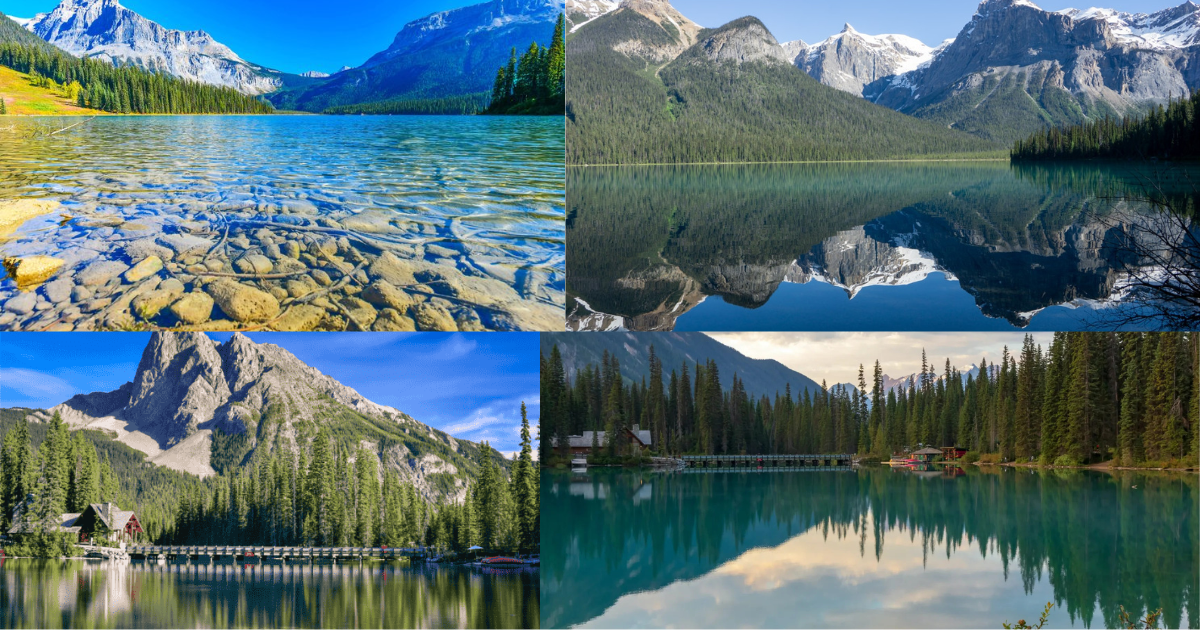
If Lake Louise is the crown jewel of Banff, then Emerald Lake is the similarly tremendous crown jewel of Yoho. Sitting at an elevation of one,302 meters and stretching over 2.5 kilometers in duration, Emerald Lake is the largest lake in Yoho countrywide Park and one of the most breathtakingly lovely lakes within the whole United States.
Yoho National Park British Columbia Canada contains the Burgess Shale fossil beds, dating back 508 million years. Its call is no exaggeration — the water glows in wealthy, bright sun shades of green and turquoise that shift and exchange with the light at some point of the day.
The lake is surrounded on all sides by dense forest and dramatic mountain peaks, developing a sense of entire and first rate isolation from the outside world. A moderate 5.2-kilometre loop path circles the whole lake, imparting cute views from each perspective. Canoe rentals are to be had throughout summer months, permitting visitors to float silently throughout the ones impossibly colored waters and revel in the lake from its maximum magical angle.
The Burgess Shale — A Window Into historical life
One of the most splendid and scientifically full-size functions of Yoho countrywide Park is something that lies now not above the ground however inside it. Yoho National Park British Columbia Canada is famous for the stunning turquoise waters of Emerald Lake.
The Burgess Shale fossil beds, observed in 1909 with the aid of American paleontologist Charles Walcott, contain a number of the exceptional-preserved fossils of gentle-bodied marine creatures from the Cambrian period — about 508 million years ago. These fossils provide an irreplaceable and thoroughly specific window into the very earliest types of complex animal lifestyles on our planet.
The Burgess Shale is so scientifically critical that it played a crucial role in shaping our modern-day knowledge of evolution and the records of lifestyles on this planet. Guided hikes to the fossil beds are available through the Burgess Shale Geoscience foundation and are strongly endorsed for all people with even a passing interest in natural records. Taking walks among these historical rocks with an informed guide is a humbling and definitely thoughts-expanding revel in.
Adventures and sports for each vacationer in Yoho National Park British
Yoho Countrywide Park gives a rich and sundry variety of outdoor sports that cater to every form of travel and every degree of fitness and experience. The park includes over 4 hundred kilometers of hiking trails, starting from mild lakeside walks to difficult multi-day backcountry routes through far flung alpine terrain. The Iceland Trail is widely considered one of the greatest day hikes in the entire Canadian Rockies. It offers jaw-dropping views of glaciers, ice fields, and mountain peaks. These breathtaking sceneries stretch endlessly in every direction.
For folks that choose water-primarily based adventures, canoeing and kayaking on Emerald Lake are famous and deeply peaceful hobbies. Mountaineering opportunities exist at some stage inside the park for knowledgeable climbers. In iciness, cross-u . s . snowboarding and snowshoeing transform the snow-protected landscape into a silent and magical playground. Wildlife watching is profitable throughout every season, with moose, black bears, grizzly bears, mountain goats, and golden eagles all calling Yoho domestic.
Conservation and responsible Tourism in Yoho
Yoho is a UNESCO World Heritage Site and a protected national park. It operates under strict conservation guidelines. These guidelines are designed to preserve its remarkable natural and scientific heritage. Future generations will benefit from this protection.
Parks Canada manages the park with a clear and unwavering commitment. Ecological integrity remains its top priority above all other concerns. Visitor numbers to sensitive areas are strictly controlled. The Burgess Shale fossil beds are one such sensitive area.
American paleontologist Charles Walcott discovered the Burgess Shale in 1909. It contains some of the best-preserved fossils of soft-bodied marine creatures. These creatures lived during the Cambrian period, approximately 508 million years ago. The fossils offer an irreplaceable window into the earliest forms of complex animal life on our planet.
The Burgess Shale is scientifically crucial. It played an important role in shaping our modern understanding of evolution. It also transformed our knowledge of the history of life on Earth.
Frequently requested Questions
Q1. Where precisely is Yoho National Park located?
Yoho National Park is located on the western slopes of the Canadian Rockies. It sits in the eastern part of British Columbia, Canada. It shares its eastern border with Banff National Park in Alberta. Its southern border connects with Kootenay National Park.
The closest town is Field, British Columbia. It is a small and charming community located right within the park boundary. The park sits approximately 85 kilometers west of Banff townsite. It is around 290 kilometers east of Vancouver via the Trans-Canada Highway.
Q2. What is an exceptional time to visit Yoho National Park?
The best time to visit Yoho National Park is from June through September. During this period, most roads and trails are fully accessible. Additionally, the weather is also at its most pleasant.
Specifically, July and August offer the warmest temperatures. Glacial melt peaks during these months, creating the most dramatic waterfall volumes. In particular, September is particularly beautiful. Golden larches transform the landscape during this time. Moreover, visitor numbers also drop significantly compared to peak summer months.
On the other hand, winter offers excellent cross-country skiing and snowshoeing opportunities. However, many roads and facilities close during this period.
Q3. How do I get to Yoho Countrywide Park?
Yoho National Park is quite simply handy via the Trans-Canada dual carriageway, which passes directly via the park. From Calgary, the force takes approximately hours heading west through Banff. From Vancouver, the pressure is approximately four to 5 hours heading east. The closest commercial airport is in Calgary, Alberta. No public transportation serves the park at once, so a condominium automobile or private automobile is strongly endorsed for travelling Yoho and exploring its many dispersed points of interest.
Q4. Do I want a permit to visit Yoho National Park?
Sure, all visitors to Yoho country wide Park require a legitimate Parks Canada Discovery bypass. Day passes are to be had at park access points and online thru the Parks Canada internet site.
An annual Discovery Pass covers unlimited access to all national parks across Canada. It is valid for a full 12 months. It represents excellent value for frequent visitors.
Guided hikes to the Burgess Shale fossil beds require separate reservations. Booking fees also apply. Visitor numbers to this sensitive site are strictly limited. This restriction helps protect the ancient fossils from damage.
.
Q5. What natural world can I assume to look in Yoho national Park?
Yoho National Park is home to a rich and diverse variety of plants and animals. This reflects the health and vitality of its protected environment. Moose are commonly spotted near lakes and wetland areas. They are most visible during early morning and evening hours.
Black bears and grizzly bears roam throughout the park. They are particularly active during berry season in summer and autumn. Mountain goats climb steep rocky terrain with ease. Bighorn sheep graze across more open areas.
Golden eagles, Clark’s nutcrackers, and several other bird species live in the park all year round. Always maintain a safe distance from all wildlife. Carry bear spray when hiking in the backcountry.
Conclusion:
There are places on this earth that truly change you just by being in them. Indeed, these places reset your sense of scale. They reawaken your sense of wonder. They remind you that the world is far greater, more beautiful, and more complex. Daily life rarely allows you to remember that.
Without doubt, Yoho National Park British Columbia Canada is without question one of these places.
Remarkably, Takakkaw Falls stuns visitors with its thundering beauty. Meanwhile, Emerald Lake captivates with its perfectly still waters. Furthermore, ancient fossils over 500 million years old tell the story of a distant past. Beyond that, trails lead deep into the very heart of the Rockies. Altogether, Yoho offers experiences that no screen can capture and no photograph can fully honor.
Therefore, go slowly, go respectfully, and go with your eyes wide open. Yoho is ready — and it has been waiting, in all its ancient and breathtaking glory, just for you.